
The Promise of Natural Change: Can Exercises Truly Alter Your Eye Angle? 🧘
The canthal tilt, the angle of the eye’s outer corner relative to its inner corner, is a powerful aesthetic marker, strongly associated with youthfulness and attractiveness. A positive, upward tilt is the aesthetic ideal, while a negative, downward tilt is often linked to a tired or aged appearance. 👁️
In the pursuit of this desirable angle, a growing movement advocates for non-invasive methods, primarily facial exercises, often grouped under the umbrella of “Face Yoga,” and specialized techniques like Myofunctional Therapy. The central question is whether these practices can exert enough force to structurally alter the canthal tilt, which is fundamentally determined by the skeletal and ligamentous attachments of the eye. 📐
This comprehensive, deeply researched analysis will critically examine the scientific literature and anatomical realities to separate the aesthetic illusion from the structural possibility. We will explore the proven benefits of facial exercises on soft tissue, the anatomical limitations of non-surgical methods, and the role of functional therapies in overall facial health. 🎯
Anatomy of the Tilt: Why It’s a Structural, Not Muscular, Feature 🦴
To understand the limitations of exercises, one must first understand the anatomy of the canthal tilt. The angle is not determined by a large, easily trainable muscle but by a fixed, structural anchor. ⚓
The Lateral Canthal Tendon: The Fixed Anchor 📌
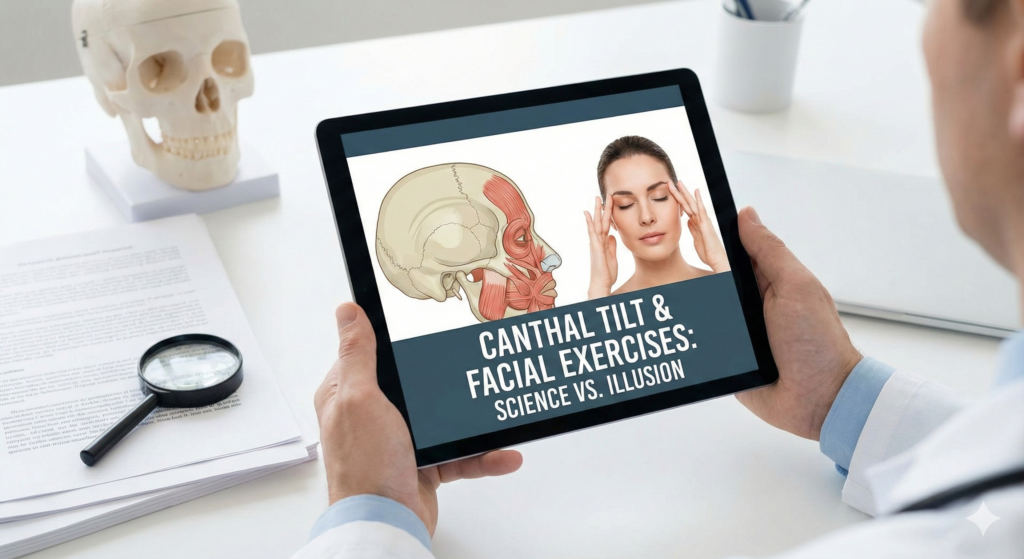
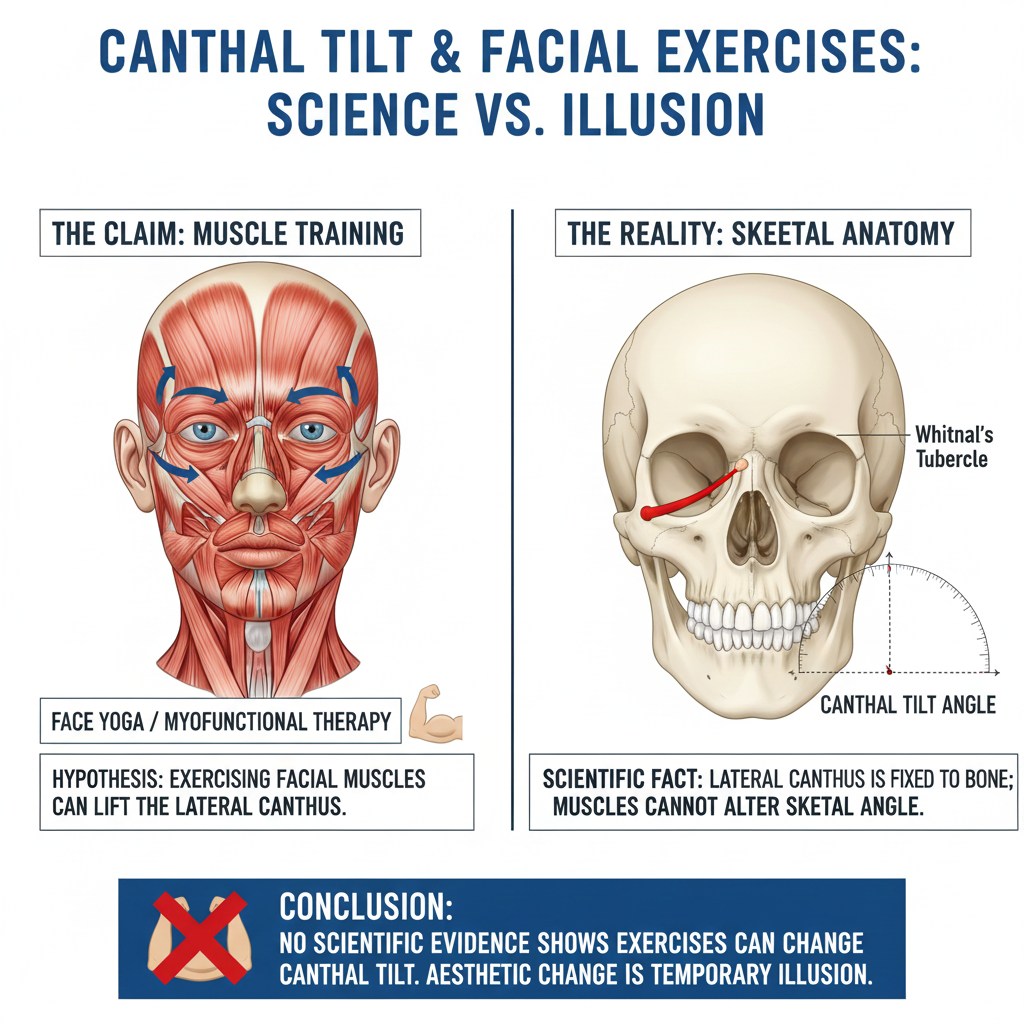
The lateral canthus (the outer corner of the eye) is held in place by the Lateral Canthal Tendon (LCT). This strong, fibrous band of tissue attaches the tarsal plates (the structural support of the eyelids) directly to the lateral orbital tubercle, a small bony prominence on the orbital rim. [1]
The canthal tilt is essentially the angle of this tendon’s attachment relative to the medial canthus. Because the LCT is a ligamentous structure anchored to the bone, its position is fixed after skeletal maturity. 🛑
Unlike skeletal muscle, which can undergo hypertrophy (growth) through exercise, the LCT and the underlying orbital bone are not directly responsive to the type of light, repetitive forces generated by facial exercises. 😔
The Role of the Orbital Bone 🦴
The position of the LCT is ultimately determined by the shape and projection of the orbital bone. In adults, the orbital bone is a fixed, mature structure. While bone undergoes constant remodeling (Wolff’s Law), the forces required to induce a significant, directional change in the orbital rim’s position are massive and sustained, far exceeding anything achievable through muscle contraction or external pressure. 💥
Therefore, the scientific consensus is clear: Facial exercises cannot structurally change the canthal tilt by altering the LCT’s attachment point or the orbital bone’s shape. ❌
The Case for Exercises: Soft Tissue Improvement and Aesthetic Illusion 🎭
While exercises cannot change the bone, they can significantly impact the surrounding soft tissue, which can create a powerful *illusion* of a more positive canthal tilt. This is where the true, scientifically-backed benefits of Face Yoga lie. 🌟
Muscle Hypertrophy and Midface Volume 📈
Studies have shown that consistent facial exercise can lead to hypertrophy of certain facial muscles. [2] This is particularly relevant to the midface: 🍎
- Cheek Muscle Toning: Strengthening the zygomatic muscles (cheek muscles) can add volume to the midface. This increased volume provides better support for the skin and fat pads beneath the eyes.
- Reduction of Under-Eye Bags: By improving muscle tone and circulation, exercises can reduce the appearance of under-eye bags and puffiness, which often contribute to the illusion of a negative canthal tilt.
When the midface is fuller and the under-eye area is tighter, the lateral canthus appears more supported and lifted, even if its actual bony position remains unchanged. This is a visual effect, not a structural one. 💡
Skin Elasticity and Circulation 🔄
A 2025 study on the effect of intensive Face Yoga found that it improved facial muscle tonus, stiffness, and elasticity. [3] Improved elasticity and circulation can: 🩸
- Tighten the Skin: Tighter skin around the eyes and temples can exert a subtle, upward pull on the soft tissue, visually lifting the entire periorbital area.
- Improve Skin Quality: Better circulation delivers more oxygen and nutrients, leading to healthier, plumper skin that reflects light better, further enhancing the appearance of youthfulness associated with a positive tilt.
Myofunctional Therapy: An Indirect, Functional Approach 🗣️
Orofacial Myofunctional Therapy (OMT) is a specialized program designed to correct improper resting posture of the tongue, lips, and jaw. While OMT is primarily focused on functional issues (e.g., breathing, swallowing), it has secondary morphological effects that are often cited in discussions of facial aesthetics. 🎯
OMT’s Primary Targets: Jaw and Palate 🦴
OMT’s most significant morphological impact is on the maxilla (upper jaw) and mandible (lower jaw), particularly in growing children. By ensuring the tongue rests against the palate (the principle behind “Mewing”), OMT aims to encourage forward and upward growth of the maxilla. ⬆️
The maxilla forms the floor of the orbit. Therefore, a successful OMT regimen that promotes upward maxillary growth could theoretically provide a better bony foundation for the entire midface, which *indirectly* supports the lateral canthus. 💡
However, this effect is: 😔
- Age-Dependent: Significant skeletal change is largely limited to children and adolescents whose growth plates are still active. In adults, the effect is minimal and limited to subtle bone remodeling.
- Indirect: It is a secondary consequence of improved skeletal support, not a direct exercise to change the canthal angle.
| Method | Target Tissue | Effect on Canthal Tilt | Scientific Evidence for Structural Change |
|---|---|---|---|
| Facial Exercises (Face Yoga) | Facial Muscles, Skin, Circulation. | Visual improvement due to soft tissue tightening and muscle hypertrophy. | None. The LCT and bone are fixed. |
| Myofunctional Therapy (OMT) | Tongue, Lips, Jaw Muscles, Maxilla (in children). | Minimal and indirect, through improved midface skeletal support (mostly in youth). | Minimal to none in adults; indirect and age-dependent in children. |
| Canthoplasty/Thread Lifts | Lateral Canthal Tendon, Subdermal Tissue. | Direct, measurable, and immediate structural change. | High. These are the only proven methods for structural change. |
The Limits of Natural Change: What Causes the Negative Tilt? 📉
The negative canthal tilt is primarily caused by factors that exercises cannot reverse: 😔
- Skeletal Morphology: A genetically determined downward slope of the orbital rim.
- Aging and Laxity: The natural weakening and stretching of the Lateral Canthal Tendon (LCT) over time, combined with the descent of the midface fat pads. This is a ligamentous and soft tissue laxity issue. [4]
- Orbital Bone Resorption: As we age, the bone around the eye socket resorbs (shrinks), which effectively widens the orbit and reduces the bony support for the LCT, contributing to a negative tilt.
Since exercises cannot tighten a stretched ligament or rebuild resorbed bone, they cannot fundamentally correct a negative canthal tilt caused by aging or genetics. ❌
Maximizing Visual Improvement: The Best Exercises for the Eye Area 🎯
Despite the structural limitations, facial exercises remain a valuable tool for maximizing the aesthetic potential of the periorbital area. The focus should be on strengthening the muscles that support the brow and midface. 💪
Targeted Exercises for a Visual Lift ⬆️
The following exercises, often recommended in Face Yoga programs, target the muscles that can visually improve the eye area: 🧘
- The Brow Lift: Placing fingers above the eyebrows and gently pushing down while simultaneously trying to raise the eyebrows. This strengthens the frontalis muscle, which can help maintain a higher brow position, visually opening the eye area.
- The “V” Exercise: Placing the index fingers on the outer canthus and the middle fingers on the inner canthus, then applying gentle pressure while squinting. This targets the orbicularis oculi muscle, aiming to improve tone and reduce crow’s feet.
- Cheekbone Sculpting: Exercises that contract the zygomatic muscles, such as exaggerated smiling while pressing the cheek skin down, can contribute to the midface volume that supports the lower eyelid.
Consistency is key. The proven benefits of these exercises—muscle toning and improved circulation—require daily, long-term commitment. ⏳
Conclusion: Realistic Expectations for Structural Change 💖
The answer to whether you can change your canthal tilt naturally with exercises is a qualified No, if “change” means altering the fixed, structural angle of the lateral canthal tendon and orbital bone. ❌
However, the answer is a resounding Yes, if “change” means achieving a significant visual improvement in the periorbital area that mimics a positive tilt. ✅
Facial exercises and OMT are invaluable tools for soft tissue health, muscle tone, and overall facial harmony. They can reduce the signs of aging and fatigue that *contribute* to the appearance of a negative tilt. For true, structural correction of a significant negative canthal tilt, surgical intervention remains the only scientifically proven method. 🎯
Embrace the power of exercises for soft tissue optimization, but maintain realistic expectations regarding skeletal and ligamentous change. 🤝
Further Exploration and Resources 📚
To explore the science of facial exercises, OMT, and the anatomy of the canthal tilt, consult these authoritative resources: 🔬
Association of Facial Exercise With the Appearance of Aging (JAMA Dermatology)
Effect of Intensive Face Yoga on Facial Muscles Tonus, Stiffness, and Elasticity (2025)
Is medial canthal tilt a powerful cue for facial attractiveness? (Anatomy)
Visual Guides to Periorbital Exercises 🎥
For visual demonstrations of the techniques and concepts discussed, these videos offer valuable insights: 📺
Tone your muscles, not your bones! 💖