


The Quest for Precision: Why Accurate Canthal Tilt Measurement Matters 📐
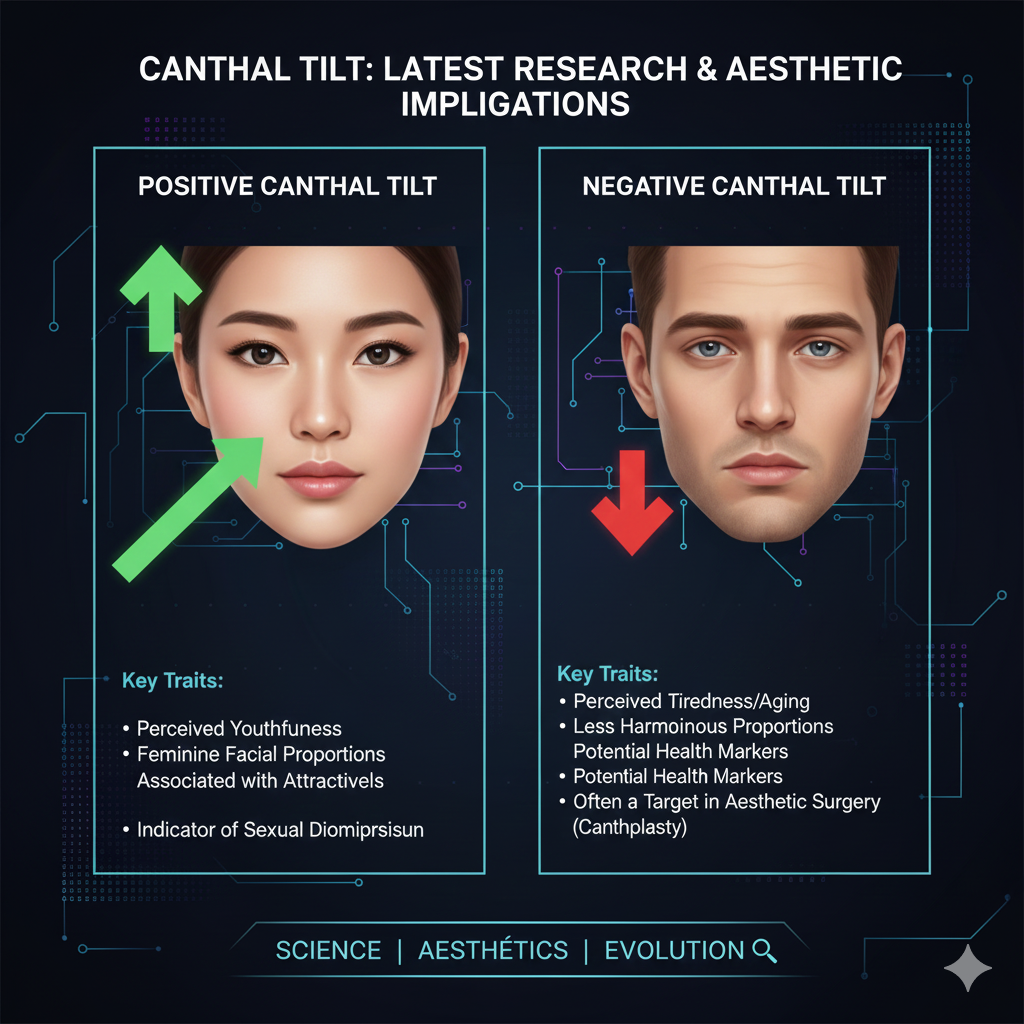
The canthal tilt, the subtle angle of the eye’s outer corner relative to its inner corner, is a powerful aesthetic determinant, influencing perceptions of youth, vitality, and attractiveness. 👁️
In the clinical setting, plastic surgeons and oculoplastic specialists rely on sophisticated 3D imaging and standardized photographic analysis to measure this angle with sub-millimeter precision. However, the desire for self-assessment has led to a surge in at-home measurement techniques. 📏
The challenge for the at-home enthusiast is to achieve a level of accuracy that is meaningful, avoiding the common pitfalls that can lead to wildly inaccurate results. A slight error in head positioning or photographic angle can skew the measurement by several degrees, turning a subtle positive tilt into a perceived negative one. 😔
This comprehensive guide will provide a detailed, step-by-step methodology for the most accurate at-home measurement of your canthal tilt, leveraging both digital tools and simple physical instruments. We will also critically compare the accuracy of these methods against the gold standard of clinical photogrammetry. 🎯
The Gold Standard: Understanding Clinical Measurement 🔬
To understand what constitutes an “accurate” at-home measurement, one must first grasp the principles of clinical photogrammetry, the standard method used by professionals. 👩⚕️
Standardized Head Positioning: The Key to Accuracy 🔑
The single most critical factor in clinical measurement is standardized head positioning. The face must be aligned to a known horizontal plane to ensure the measurement is a true reflection of the canthal angle and not an artifact of head tilt. 🔄
The most common reference plane is the Frankfort Horizontal Plane (FHP), an imaginary line passing from the lowest point of the orbit (eye socket) to the highest point of the external auditory meatus (ear canal). [1]
In a clinical setting, a cephalostat or specialized headrest is used to ensure the FHP is perfectly parallel to the ground. Without this standardization, any angular measurement is unreliable. ❌
The Canthal Tilt Formula 📐
The canthal tilt is the angle formed by the line connecting the lateral canthus (LC) and the medial canthus (MC) relative to the FHP. Mathematically, this is often calculated using the coordinates of the two points: 📈
Angle = arctan((Y_LC – Y_MC) / (X_LC – X_MC))
A positive angle indicates a positive tilt (LC is higher than MC), and a negative angle indicates a negative tilt (LC is lower than MC). The goal of at-home measurement is to replicate this process as closely as possible. 🎯
Method 1: Digital Photographic Analysis (Highest At-Home Accuracy) 💻
The most accurate at-home method involves using a high-resolution photograph and digital editing software. This method best simulates the clinical process. ✅
Step 1: Standardized Photography Setup 📸
This step is the most crucial for accuracy: 🔑

- Camera Distance: Use a camera (smartphone or DSLR) positioned at least 5 feet (1.5 meters) away from your face to minimize lens distortion, which is common in close-up selfies. 📏
- Head Position: The biggest challenge is replicating the FHP. Sit facing a mirror. Use a long, thin object (like a ruler or a chopstick) and hold it horizontally, aligning it with the bottom of your eye socket and the top of your ear canal. Have a friend take the photo while you maintain this position. The camera lens must be at the same height as your eyes. 🔄
- Facial Expression: Maintain a neutral, relaxed expression. Do not squint or force your eyes open, as this can artificially alter the canthal position. 😐
Step 2: Digital Measurement with Software 💻
Once you have the standardized photo, you can use any image editing software (e.g., Photoshop, GIMP, or even free online image editors with angle measurement tools) to perform the analysis. 🛠️
- Establish the Horizontal Reference: Draw a perfectly horizontal line across the image. This line should be parallel to the ruler you used to align your FHP. This is your zero-degree reference. ↔️
- Draw the Canthal Line: Draw a second line connecting the center of the medial canthus (MC) to the center of the lateral canthus (LC). 🎯
- Measure the Angle: Use the software’s angle measurement tool to find the angle between the horizontal reference line and the canthal line. The resulting number is your canthal tilt in degrees. 📐
This method, when performed with meticulous attention to head positioning, can yield results within ±2 degrees of a clinical measurement. [2]
Method 2: Physical Protractor and Mirror (Quick and Practical) 📏
For a quick, non-digital assessment, a physical protractor can be used, though its accuracy is significantly lower than the digital method. 😔
Step 1: The Setup and Stabilization 🛠️
You will need a mirror, a clear plastic protractor, and a steady hand. 🖐️
- Head Position: Again, align your head to the FHP using a ruler as described in Method 1. This is non-negotiable for a meaningful result. 🔑
- Protractor Placement: Place the protractor against the mirror, aligning the 90-degree mark with the center of your eye. The straight edge of the protractor should be perfectly horizontal, parallel to your FHP reference. ↔️
Step 2: Visual Estimation and Reading 🧐
This method relies heavily on visual estimation: 👁️
- Align the Canthus: Visually align the protractor’s baseline with the medial canthus (MC).
- Read the Angle: Observe where the lateral canthus (LC) falls on the protractor’s arc. This is your canthal tilt.
Due to parallax error (the apparent shift in position when viewed from different angles) and the difficulty of maintaining a perfect FHP, this method is prone to errors of ±5 degrees or more. It is best used for a rough, qualitative assessment (e.g., “Is it positive or negative?”). 📉
Common Pitfalls and How to Avoid Them ⚠️
The difference between an accurate at-home measurement and a useless one lies in avoiding these common errors: 🛑
| Pitfall | Impact on Measurement | Correction (The Accurate Method) |
|---|---|---|
| Head Tilt (Yaw) | Creates an artificial tilt, often exaggerating a positive or negative angle. | Use the Frankfort Horizontal Plane (FHP) alignment with a physical ruler/chopstick. |
| Close-Up Photography | Lens distortion (barrel distortion) warps the face, especially at the edges. | Take the photo from at least 5 feet (1.5m) away, using the zoom function if necessary. |
| Non-Neutral Expression | Muscle contraction (squinting) pulls the lateral canthus, altering the true resting angle. | Maintain a completely relaxed, neutral facial expression during the photo. |
Digital Tools and Apps: Promises and Limitations 📱
The market is saturated with apps and online tools that promise instant facial analysis, including canthal tilt measurement. While convenient, their accuracy is highly variable. 😔
AI-Based Landmark Detection 🤖
The most sophisticated apps use Artificial Intelligence (AI) to automatically detect the medial and lateral canthi. This is a powerful feature, but the accuracy is only as good as the input image. 📸
If the photo is not taken with standardized head positioning (the FHP is not level), the AI will accurately measure the angle of a tilted head, giving you a precise but inaccurate reading of your true canthal tilt. [3]
Therefore, even with AI tools, the user must ensure the input photograph is taken under the strict conditions of Method 1. 🔑
Interpreting Your Results: What the Angle Means 📈
Once you have a measurement, it’s important to interpret it correctly in the context of aesthetic ideals: 🎯
- Positive Tilt (e.g., +4° to +8°): This is the ideal range. It is associated with youthfulness and attractiveness. A tilt in this range is considered highly desirable. ✅
- Neutral Tilt (e.g., -1° to +3°): This is common in the general population. It is not necessarily unattractive but lacks the “lifted” quality of a strong positive tilt. ⚖️
- Negative Tilt (e.g., -2° or lower): This is often associated with a tired, sad, or aged appearance. It is the primary target for aesthetic correction. 😔
Remember that the ideal tilt is also sexually dimorphic, with the feminine ideal often being a few degrees higher than the masculine ideal. 🚻
Conclusion: The Power of Standardized Photography 💖
The most accurate way to measure your canthal tilt at home is through standardized digital photographic analysis. This method, which meticulously controls for head position using the Frankfort Horizontal Plane, is the only way to minimize the error inherent in 2D measurement. 🎯
While physical tools like protractors offer a quick, rough estimate, they are insufficient for the precision required for meaningful aesthetic self-assessment. By following the detailed steps for Method 1, you can obtain a reliable measurement that serves as a valuable baseline for any future aesthetic or surgical consultation. 🤝
Accuracy in measurement is the first step toward informed self-improvement. 🌟
Further Exploration and Resources 📚
To explore the science of canthal tilt measurement and its clinical applications, consult these authoritative resources: 🔬
Diagnostic analysis of vertical orbital dystopia and canthal tilt (2020)
Standardized portrait photography for dental patients (Clinical Photography)
Standardised anatomical alignment of the head in a clinical photography studio (FHP)
Visual Guides to Photographic Measurement 🎥
For visual demonstrations of the techniques and concepts discussed, these videos offer valuable insights: 📺
Measure twice, cut once! 💖