


The “Chad Face” has transcended its origins as an internet meme to become a shorthand for a specific, highly-masculine, and aesthetically-pleasing facial structure.
This phenomenon is not merely a cultural construct; it is deeply rooted in the biological markers of health, dominance, and reproductive fitness that humans are instinctively drawn to.
To truly understand the allure of the Chad face, one must move beyond the meme and analyze the precise anatomical features that contribute to this powerful look.
This analysis requires a detailed breakdown of the individual components and a clear comparison against the more common, or “average,” male face.
The foundation of the Chad face is a robust and well-developed bone structure.
This is often a result of optimal growth during adolescence, influenced by factors like genetics, diet, and even breathing patterns.
The key features are not subtle; they are pronounced, angular, and convey a sense of strength and definition.
The Defining Features of the Chad Face
The Chad face is a collection of features that, when combined, create a look of striking symmetry and angularity.
The most critical components include the jawline, the midface, and the orbital area.
The Chiseled Jawline and Gonial Angle
Perhaps the most recognized feature of the Chad face is the sharp, square jawline.
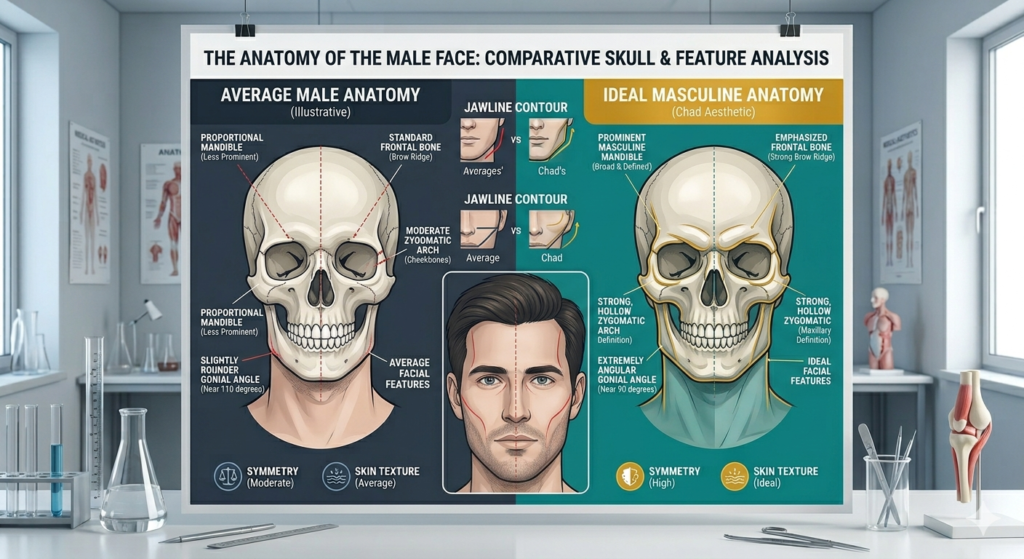
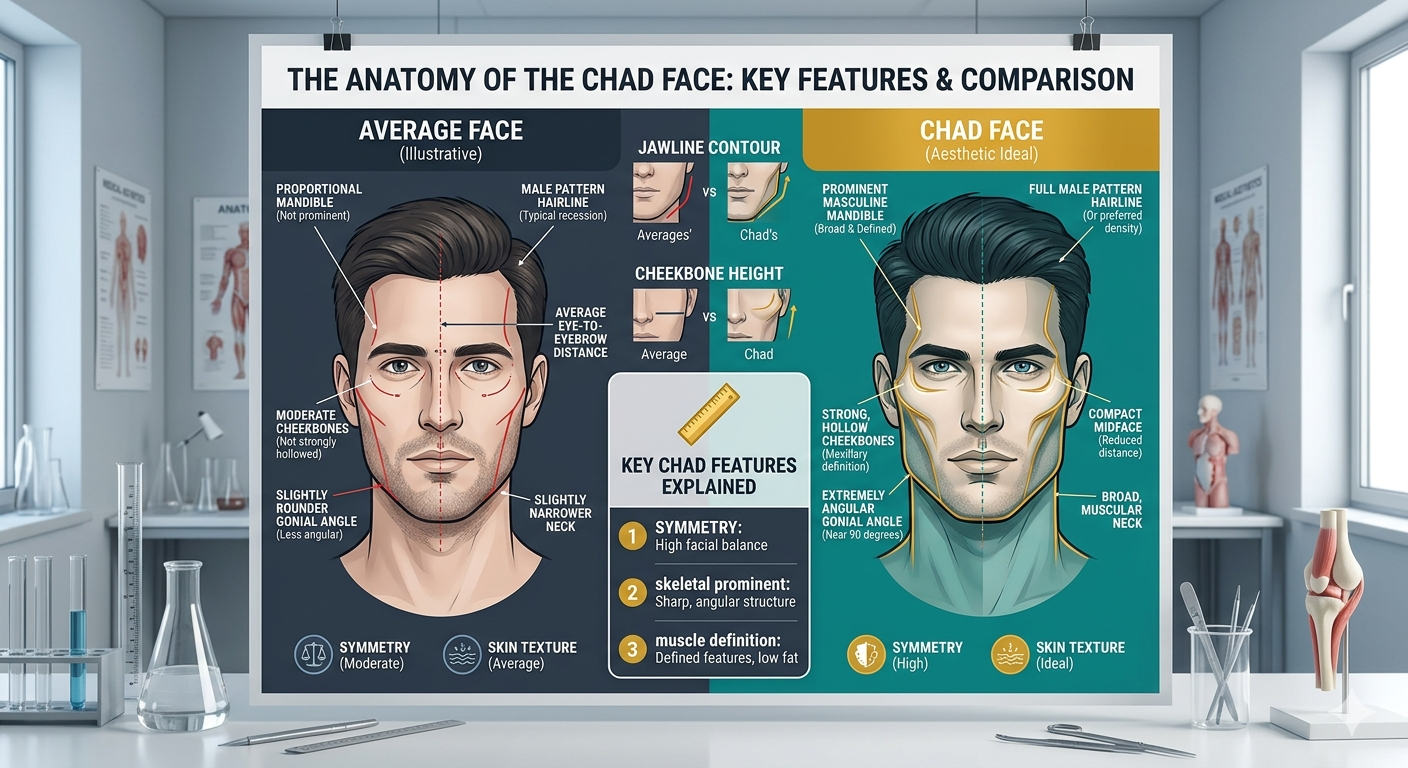
This is characterized by a low, well-defined gonial angle—the angle at the back of the jaw where the mandible turns upward.
In a Chad face, this angle is closer to 90 degrees, creating a strong, almost right-angled corner.
This contrasts sharply with the average face, where the gonial angle is often more obtuse, leading to a softer, more rounded appearance.
The jawline is not just wide; it is also projected forward, contributing to a strong profile.
The masseter muscles, which are responsible for chewing, are typically well-developed, adding to the squareness of the lower face.
This muscular definition further enhances the chiseled look.
The Prominent Brow Ridge and Orbital Area
Another non-negotiable feature is a prominent brow ridge, or supraorbital rim.
This heavy, forward-projecting bone structure above the eyes is a classic marker of high testosterone exposure during development [3].
It creates a deep-set appearance for the eyes, which is a key component of the coveted “hunter eyes.”
The brow ridge provides a natural shadow over the eyes, lending an intense, focused, and sometimes intimidating gaze.
In the average face, the brow ridge is often flatter and less pronounced, resulting in eyes that appear more exposed and less shadowed.
This difference in the orbital area is crucial for the overall aesthetic impact.
Hunter Eyes and Positive Canthal Tilt
The eyes themselves are a defining characteristic.
The Chad face almost invariably features “hunter eyes,” which are narrow, horizontally aligned, and deep-set.
The opposite, “prey eyes,” are rounder and more exposed.
The canthal tilt, the angle formed by the inner and outer corners of the eye, is often neutral or slightly positive in the Chad face.
A positive canthal tilt, where the outer corner is slightly higher than the inner corner, is universally associated with youth and attractiveness [1].
This feature, combined with the deep-set nature provided by the brow ridge, creates the intense, focused look that is central to the Chad aesthetic.
For a deeper understanding of this specific feature, you can read our article on Understanding Hunter Eyes: Negative vs Positive Canthal Tilt.
https://www.youtube.com/watch?v=aQkPq-741_Y
High Cheekbones and Midface Projection
The midface, the area from the eyes to the upper lip, is also highly projected in the Chad face.
This is largely due to high, forward-projecting cheekbones (zygomatic bones).
These high cheekbones create a natural contour and shadow beneath them, further emphasizing the angularity of the face.
This projection prevents the face from appearing flat and contributes significantly to the overall three-dimensional structure.
The average face often has flatter cheekbones, which can make the midface appear less defined and more two-dimensional.
The Chad Face vs. The Average Face: A Comparative Analysis
The distinction between the Chad face and the average face is not a matter of subjective beauty but a measurable difference in craniofacial morphology.
The average male face is, by definition, the statistical mean of the population, and it lacks the extreme, pronounced features of the Chad face.
| Feature | Chad Face (High Masculinity) | Average Male Face (Statistical Mean) |
|---|---|---|
| Jawline | Square, wide, low gonial angle (near 90°), strong forward projection. | Rounded, narrower, obtuse gonial angle, less forward projection. |
| Brow Ridge | Prominent, heavy, forward-projecting, creating deep-set eyes. | Flatter, less pronounced, eyes appear more exposed. |
| Eyes | Hunter eyes (narrow, deep-set, horizontal or positive canthal tilt). | Prey eyes (rounder, more exposed, often neutral or negative canthal tilt). |
| Cheekbones | High, prominent, and forward-projecting (zygomatic projection). | Flatter, less defined, contributing to a more two-dimensional midface. |
| Facial Height | Often shorter (brachycephalic tendency), contributing to a more compact, powerful look. | Often longer (dolichocephalic tendency), leading to a less compact appearance. |
The differences highlighted in the table are all interconnected and often stem from the same underlying developmental factors.
The Chad face represents a phenotype that is high in sexual dimorphism—the physical differences between males and females of a species.
These highly masculine features are often perceived as indicators of genetic quality and robust health [2].
The Role of Hormones and Development
The development of the Chad face features is heavily influenced by hormones, particularly testosterone, during puberty.
High levels of testosterone are linked to the growth of the brow ridge, the widening of the jaw, and the overall robusticity of the craniofacial skeleton.
This biological link is why the Chad face is often subconsciously associated with strength and dominance.
The question of whether a strong jawline directly correlates with high testosterone is a fascinating one, and we explore it in detail in our article, Does a Strong Jawline Mean High Testosterone?.
https://www.youtube.com/watch?v=V-gY-02Q4wQ
The Cultural Impact and the Meme
The “Chad” meme, often paired with the “Virgin” meme, is a cultural exaggeration of these biological truths.
The Chad figure is depicted as effortlessly successful, confident, and physically superior, all symbolized by his striking facial features.
This cultural phenomenon has, in turn, driven interest in facial aesthetics and the pursuit of a more defined look.
While the meme is satirical, it draws its power from the universal human appreciation for the specific facial geometry that the Chad face embodies.
For a broader context on this aesthetic, consider reading our guide on Chad Beauty: A Guide to Male Model Face Types.
Achieving the Aesthetic: Beyond Genetics
While genetics lay the groundwork, certain lifestyle factors and practices can influence the expression of these features.
Proper tongue posture, a practice known as Mewing, is often cited as a way to encourage forward growth of the maxilla and mandible, which can enhance midface projection and jawline definition.
Furthermore, maintaining a low body fat percentage is crucial, as even the most perfectly structured jawline will be obscured by excess subcutaneous fat.
The Chad face is more than just a passing trend; it is a modern articulation of timeless aesthetic principles.
It represents a confluence of biological markers for health and dominance, amplified by a culture that values sharp, angular features.
By understanding the anatomy and the comparison to the average face, one can appreciate the complex interplay of genetics, hormones, and development that creates this striking and dominant look.
The pursuit of this aesthetic is a pursuit of symmetry, projection, and the powerful visual communication of strength.
References
1. Facial masculinity and attractiveness: a review and synthesis.
2. What Makes a Face Attractive.
3. Testosterone and facial features.