

Introduction: The Science of the “Alpha” Face 🤓
In the highly competitive world of male modeling and aesthetics, success often boils down to a single, powerful factor: facial structure.
Beyond symmetry and clear skin, a specific geometric measurement—the Facial Width-to-Height Ratio (fWHR)—has been identified by researchers as a key predictor of perceived masculinity, dominance, and, critically, attractiveness.
The fWHR is a simple, yet profound, metric that compares the width of the face to its height.
It is a ratio that has captured the attention of evolutionary psychologists, neuroscientists, and, increasingly, those in the aesthetic and modeling industries.
This ratio is not just about looking good; it’s about signaling underlying biological traits that have been favored by sexual selection.
For male models, understanding and possessing the “ideal” fWHR can be the difference between a successful career and obscurity.
This guide will break down what the fWHR is, how it’s measured, and why a specific range is considered the golden metric for the male aesthetic.
What is the Facial Width-to-Height Ratio (fWHR)? 📏
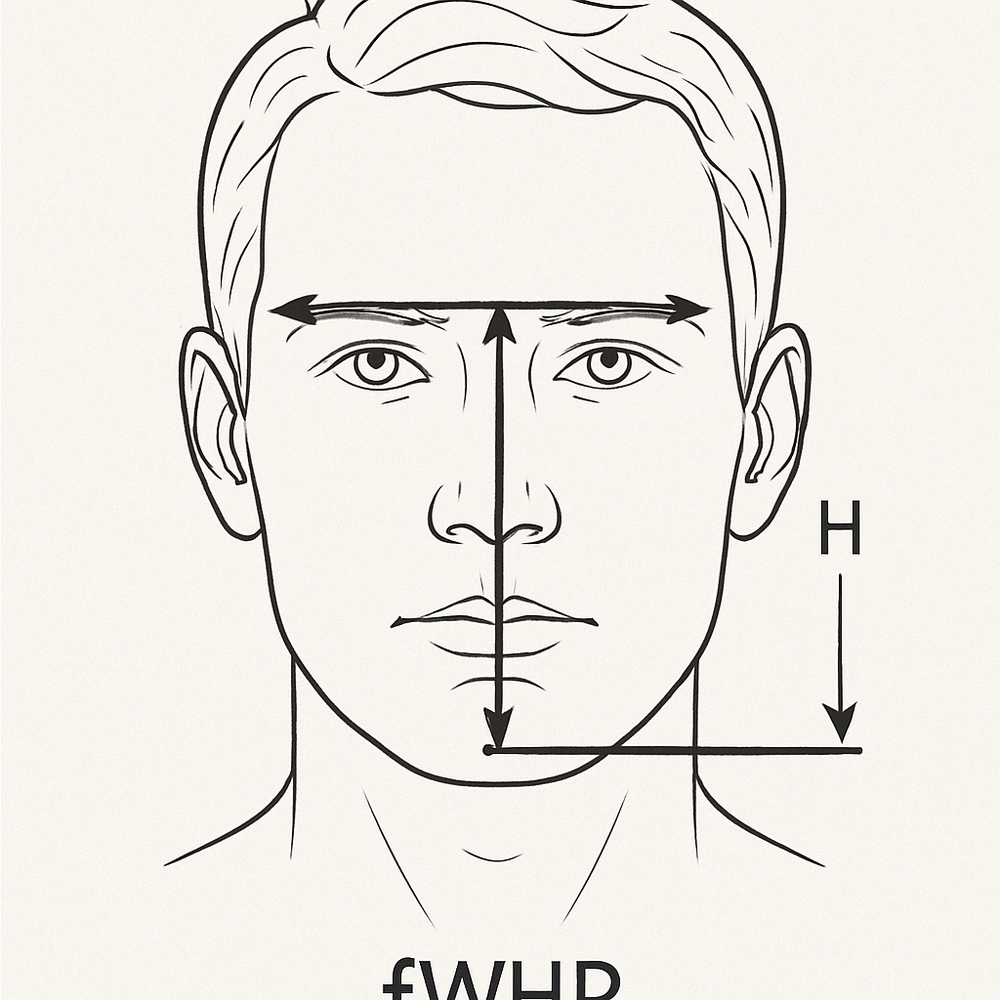
The fWHR is calculated by dividing the bizygomatic width (the distance between the left and right cheekbones) by the upper facial height (the distance between the upper lip and the brow line).
This ratio is distinct from the classical Golden Ratio (1:1.618) often applied to overall facial proportions.
The fWHR is a measure of the face’s relative broadness or squareness.
A higher fWHR indicates a wider, shorter, and more “square” face, while a lower fWHR indicates a narrower, longer face.
Research has consistently shown that this ratio is sexually dimorphic, meaning it differs significantly between men and women.
Men generally have a higher fWHR than women, a difference that is believed to be driven by testosterone exposure during puberty, which promotes lateral growth of the cheekbones fWHR and Testosterone.
The fWHR is considered a static trait, meaning it does not change significantly in adulthood, making it a reliable indicator of underlying biological factors.
The fWHR is a simple geometric measure that acts as a powerful, non-verbal signal of male biological traits.
The Ideal Range for Male Models 🎯
While the average fWHR for men is often cited around 1.86, studies focusing on perceived attractiveness and dominance have pinpointed a slightly higher range as being most desirable for the male aesthetic, particularly in the context of modeling.
The ideal range for a male face, which is consistently rated as highly attractive, dominant, and masculine, falls between 1.8 to 2.0.
Faces that fall within this range are perceived as having a more robust, powerful, and “alpha” appearance.
A ratio closer to 2.0 suggests a face that is significantly wider relative to its height, a feature strongly associated with high testosterone levels and, consequently, perceived dominance and aggression fWHR and Dominance.
In the modeling industry, this “wider” look is often translated into the desired “chiseled” or “strong” jawline and cheekbone structure.
Male models who possess this higher fWHR often convey a sense of ruggedness and authority, making them highly sought after for high-fashion and commercial campaigns.
It is this subtle difference from the average that contributes to the striking visual impact of a model’s face.
The ideal fWHR for male models is a high ratio, signaling a robust, testosterone-driven facial structure.
fWHR and Perceived Traits 🧠
The psychological impact of the fWHR is perhaps more fascinating than the measurement itself.
A higher fWHR in men is not just linked to attractiveness; it is also consistently associated with a suite of behavioral and personality traits, including:
- Dominance: Men with higher fWHR are perceived as more dominant and intimidating.
- Aggression: Studies have linked a higher ratio to self-reported aggression and a greater propensity for aggressive behavior.
- Achievement Drive: A higher fWHR has been associated with a greater drive for achievement and success in competitive environments.
- Trustworthiness: Conversely, men with a higher fWHR are sometimes perceived as less trustworthy or cooperative in initial social judgments.
These perceptions are largely unconscious and automatic, suggesting an evolutionary basis for the importance of this ratio.
In the context of modeling, the perception of dominance and rugged masculinity is a desirable trait, which explains why models with a higher fWHR are often favored.
The face is, in essence, a billboard for biological and behavioral signals.
The fWHR acts as a powerful, non-conscious cue that influences social perceptions of a man’s character and potential.
How to Measure Your Own fWHR 📐
Calculating your fWHR is straightforward, requiring only a clear, front-facing photograph and a ruler or digital measurement tool. 💡
| Measurement | Definition | Points of Reference |
|---|---|---|
| Width (W) | Bizygomatic Width | Distance between the left and right zygomatic arches (cheekbones). |
| Height (H) | Upper Facial Height | Distance from the top of the upper lip to the brow line (glabella). |
| Ratio | W / H | The resulting number is your Facial Width-to-Height Ratio. |
For example, if your bizygomatic width is 140mm and your upper facial height is 75mm, your fWHR is 140 / 75 ≈ 1.87.
This places you squarely in the attractive range, slightly above the male average.
It is important to use a neutral, expressionless photograph taken directly from the front for the most accurate measurement.
Can You Change Your fWHR? 🛠️
Since the fWHR is primarily determined by skeletal structure, which is set by genetics and growth during puberty, it is considered a relatively fixed trait in adulthood.
However, aesthetic procedures and lifestyle changes can influence the perception of the ratio, making a face appear wider or shorter.
Non-surgical methods to enhance the appearance of a high fWHR include:
- Masseter Botox: Injecting Botox into the masseter muscles (jaw muscles) can slim the lower face, which can slightly lower the perceived fWHR, though this is often done to treat teeth grinding.
- Dermal Fillers: Injecting fillers into the cheekbones (zygomatic arches) can increase the facial width, thus increasing the fWHR.
- Hair and Beard Style: Strategic use of hair and beard can create visual illusions. A shorter haircut and a square, well-groomed beard can emphasize the jawline and cheekbones, making the face appear wider and shorter.
While these methods do not change the underlying bone structure, they are effective tools for aesthetic optimization, particularly for those in the modeling industry Aesthetic Optimization of Facial Ratios.
The goal is to maximize the visual impact of the natural bone structure.
Conclusion: The Ratio of Success 💯
The Facial Width-to-Height Ratio is more than just a number; it is a quantifiable link between facial geometry and deeply ingrained human perceptions of masculinity and dominance.
For male models, the ideal fWHR—a ratio between 1.8 and 2.0—is a key physical asset that signals a powerful and attractive presence.
While the ratio itself is largely genetic, understanding it allows for targeted aesthetic and styling choices to maximize its visual impact.
Whether you are an aspiring model or simply interested in facial aesthetics, the fWHR provides a fascinating lens through which to view the science of attraction.
Embrace the geometry of your face, and let the science guide your aesthetic choices.
Key Takeaways and Actionable Steps ✅
- Ideal Male fWHR: The most attractive and dominant range is between 1.8 and 2.0.
- Measurement: Divide bizygomatic width (cheekbones) by upper facial height (brow to upper lip).
- Aesthetic Enhancement: Use cheekbone fillers or strategic hair/beard styling to visually increase the width (W) and emphasize the ratio.
- Psychological Impact: A higher ratio is unconsciously linked to perceived dominance, aggression, and high testosterone.
- Modeling Relevance: This ratio is a key factor in casting for roles requiring a strong, masculine, or authoritative look.
The geometry of your face is a powerful tool—learn to measure it, understand it, and leverage it.
Go forth and conquer! 📌