


Introduction: Beyond the Buzzword 🤓
The term “strong jawline” has become a ubiquitous shorthand for facial attractiveness, particularly in men.
It conjures images of chiseled, defined contours that signal vitality, confidence, and youth.
However, within the precise field of craniofacial aesthetics, the popular concept of a “strong jawline” is often conflated with a distinct, yet related, feature: the “wide jawline.”
While both features contribute to a powerful facial profile, they are anatomically distinct, driven by different skeletal dimensions, and achieved through entirely different means.
Confusing the two can lead to misguided aesthetic goals and ineffective enhancement strategies.
A jawline can be incredibly wide but lack projection, resulting in a square but recessed appearance.
Conversely, a jawline can be highly projected and defined, yet relatively narrow, leading to a sharp but less dominant look.
This comprehensive guide will deconstruct the anatomy of the lower third of the face, clearly defining the “strong jawline” by its vertical and horizontal projection, and the “wide jawline” by its transverse dimensions.
Understanding this critical difference is the first step toward achieving true facial harmony and optimizing your profile.
Anatomy 101: The Mandibular Blueprint 🦴
The jawline is formed by the mandible, the largest and strongest bone of the face.
Its shape is determined by three primary anatomical features, each contributing differently to the overall aesthetic:
- The Pogonion (Chin Point): This is the most anterior (forward) point of the chin. Its position dictates the projection of the jawline in profile.
- The Gonial Angle (Jaw Angle): This is the corner where the body of the mandible meets the ramus (the vertical part). The sharpness and angle of this corner define the definition and vertical height of the posterior jaw.
- The Bigonial Width: This is the distance between the two gonial angles. It dictates the width or squareness of the lower face.
The soft tissues overlying these bones—the masseter muscle and the subcutaneous fat—also play a crucial role, but the underlying bone structure is the ultimate determinant of the jawline’s potential.
A truly aesthetic jawline is a harmonious combination of these three dimensions, not just an exaggeration of one.
The Strong Jawline: Projection and Definition 💪
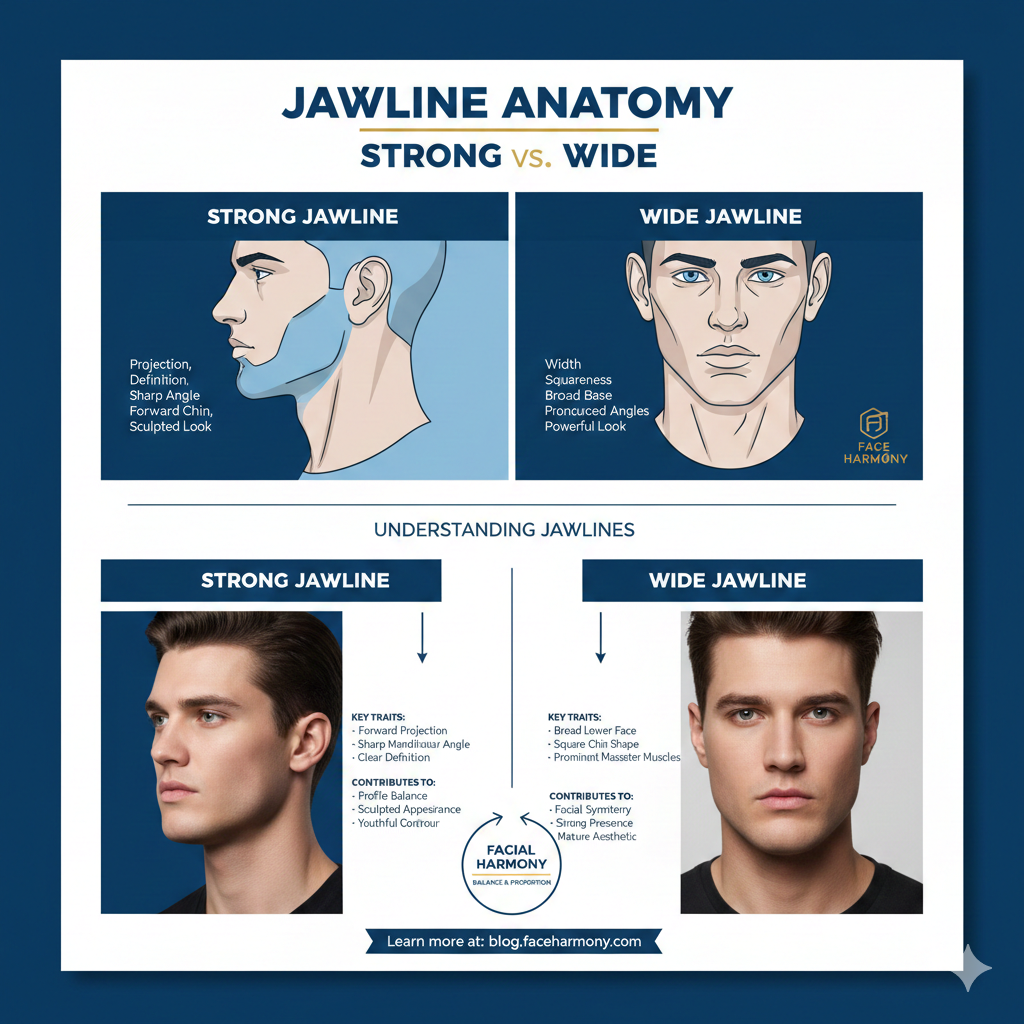
A “strong jawline” is primarily a measure of its **projection** and **definition** in the sagittal (side) view.
It is defined by two key anatomical characteristics:
1. Mandibular Projection (The Chin)
Projection refers to how far forward the chin extends relative to the rest of the face, particularly the forehead and nose.
In profile, a strong jawline means the chin (pogonion) is aligned with or slightly anterior to the lower lip, creating a balanced lower third of the face.
A lack of projection, known as microgenia or a recessed chin, is the hallmark of a “weak” jawline, regardless of how wide the jaw might be.
This forward growth is crucial because it provides tension to the soft tissues of the neck, eliminating the appearance of a double chin and creating a sharp cervicomental angle (the angle between the neck and the chin) The Aesthetic Importance of Chin Projection.
2. Gonial Angle Definition
Definition refers to the sharpness of the mandibular border and the angle of the jaw (gonial angle).
A strong jawline typically has a low mandibular plane angle (closer to horizontal) and a gonial angle close to 90 degrees.
This creates a distinct, sharp line separating the face from the neck.
A high mandibular plane angle, often associated with vertical facial growth patterns, results in a less defined, more obtuse jaw angle, which is aesthetically perceived as weaker.
In summary, a strong jawline is about how far forward and how sharply defined the jaw is in profile.
The Wide Jawline: Transverse Dimension and Squareness 🟦
A “wide jawline” is a measure of its **transverse dimension** in the frontal (front) view.
It is defined by the bigonial width, the distance between the two jaw angles.
1. Bigonial Width and Masseter Hypertrophy
A wide jawline is characterized by a large bigonial width, often approaching or even exceeding the bizygomatic width (cheekbone width).
This creates a square, powerful appearance to the lower face.
While the underlying bone structure (mandible) dictates the maximum width, the size of the masseter muscle is a major contributing factor.
Masseter hypertrophy (enlargement of the chewing muscle) due to genetics or excessive chewing can significantly increase the bigonial width, leading to a distinctly square jawline.
2. The Facial Width-to-Height Ratio (fWHR)
The wide jawline is intrinsically linked to the Facial Width-to-Height Ratio (fWHR), which is a key metric in facial aesthetics.
A higher fWHR, indicating a face that is wide relative to its height, is a strong signal of a wide jawline.
This ratio is often associated with high testosterone levels and is unconsciously perceived as a sign of dominance, aggression, and masculinity fWHR and Perceived Dominance.
In summary, a wide jawline is about the transverse dimension of the lower face, creating a square or rectangular shape.
The Aesthetic Dichotomy: Gender and Cultural Ideals 🎭
The distinction between strong and wide is crucial because the aesthetic ideal differs significantly between genders and across cultures.
A. The Male Ideal: Strong and Wide
For men, the ideal jawline is typically both strong and wide.
A high degree of mandibular projection (strong chin) combined with a large bigonial width (wide jaw) creates the coveted chiseled, square look that maximizes the fWHR.
This combination signals robust skeletal health, high testosterone, and dominance, which are universally attractive male traits.
A jawline that is wide but not projected will appear heavy and recessed, while a jawline that is projected but not wide may appear sharp but less powerful.
B. The Female Ideal: Strong but Narrow
For women, the ideal is a jawline that is **strong** (high projection and sharp definition) but **narrow** (low bigonial width).
A strong chin and a defined mandibular border provide a youthful, vital appearance, but a wide, square jawline is often perceived as overly masculine.
The female ideal often favors a “V-line” or heart-shaped face, where the bigonial width is significantly less than the bizygomatic width, creating a soft, feminine taper to the lower face Gender Differences in Jawline Aesthetics.
Therefore, a woman seeking a “strong jawline” is typically looking for definition and projection, not necessarily increased width.
Strategies for Enhancement: Targeting the Right Dimension 🎯
Understanding the difference between strength and width is paramount for choosing the correct enhancement strategy.
| Aesthetic Goal | Anatomical Target | Non-Surgical Method | Surgical Method |
|---|---|---|---|
| Increase Strength/Projection | Pogonion (Chin Point) | Dermal Fillers (Chin Augmentation), Orthodontics, Mewing. | Genioplasty (Chin Advancement), Mandibular Implants. |
| Increase Definition/Sharpness | Mandibular Border/Gonial Angle | Fat Reduction (Kybella/Liposuction), Skin Tightening (RF/Ultherapy). | Neck Lift, Jaw Angle Implants. |
| Increase Width/Squareness | Bigonial Width/Masseter Muscle | Masseter Hypertrophy (Chewing Exercises), Jawline Fillers. | Custom Mandibular Implants. |
| Decrease Width/Squareness | Masseter Muscle | Masseter Botox (Muscle Atrophy). | Mandibular Angle Reduction (Bone Shaving). |
For those seeking a **strong** jawline, the focus must be on **projection** and **definition**.
For those seeking a **wide** jawline, the focus is on **bigonial width** and **masseter size**.
The most common mistake is attempting to fix a recessed chin (lack of strength/projection) by only focusing on the width, which often leads to a heavy, square, but still weak-looking profile.
The Interplay: When Strength and Width Converge 🤝
While anatomically distinct, the most aesthetically pleasing jawlines often represent a perfect convergence of both strength and width.
This is achieved when a robust bigonial width is perfectly complemented by a strong chin projection and a sharply defined mandibular border.
This ideal structure provides the necessary skeletal support for the soft tissues, ensuring that the face resists the effects of gravity and aging.
As the facial skeleton ages, bone resorption occurs in both the chin (reducing projection) and the jaw angle (reducing definition and width) Aging of the Mandible and Aesthetic Implications.
Therefore, a jawline that is both strong and wide in youth has a greater reserve of bone mass to resist these age-related changes, maintaining a youthful appearance for longer.
The ultimate goal is not merely to be wide or strong, but to achieve a balanced, harmonious lower third of the face that is proportional to the midface (cheekbones) and upper face (forehead).
This balance is the true secret to a timelessly attractive jawline.
https://youtu.be/YOUTUBE_URL_1
https://youtu.be/YOUTUBE_URL_2
https://youtu.be/YOUTUBE_URL_3
Key Takeaways and Actionable Steps ✅
- Strong Jawline: Defined by **Projection** (how far forward the chin extends) and **Definition** (the sharpness of the mandibular angle).
- Wide Jawline: Defined by **Bigonial Width** (the distance between the jaw angles) and the size of the masseter muscle.
- Male Ideal: Typically requires both high strength/projection and high width/squareness.
- Female Ideal: Typically requires high strength/projection but lower width/squareness (V-line).
- Actionable Step: If your chin is recessed, focus on projection (fillers/genioplasty) before focusing on width. If your chin is projected but your jaw is narrow, focus on width (chewing/implants).
Know your anatomy, define your goal, and choose the right strategy to sculpt your ideal jawline.
The power to define your profile is in the details! 📌