



Introduction: The Craniofacial-Cervical System 🤓
When you look in the mirror, you see the result of genetics, diet, and time.
But what you might not realize is that the shape of your face—the prominence of your jawline, the definition of your cheekbones, and even the alignment of your teeth—is profoundly influenced by something you do every second of the day: your posture.
The human head, weighing approximately 10 to 12 pounds, is balanced precariously atop the cervical spine (neck).
Any deviation from a neutral, balanced position initiates a cascade of muscular and skeletal compensations that ripple directly into the delicate bone structure of the face.
This is the essence of the craniofacial-cervical system, a biomechanical unit where the position of the head dictates the resting position of the jaw, which in turn influences the growth and remodeling of the facial bones.
This comprehensive guide delves into the scientific evidence linking poor posture, particularly the ubiquitous “Forward Head Posture,” to detrimental changes in facial bone structure and offers actionable strategies for correction.

The Biomechanical Chain: Head, Hyoid, and Jaw 🔗
To understand the link, one must first appreciate the role of the hyoid bone, a small, U-shaped bone situated in the neck, suspended by muscles and ligaments.
The hyoid bone is unique because it is the only bone in the human body that does not articulate with any other bone.
Instead, it serves as the anchor point for the muscles of the tongue, the floor of the mouth, and the larynx.
The position of the hyoid bone is directly influenced by the posture of the head and neck.
When the head is in a neutral, upright position, the hyoid bone is naturally positioned high and forward, which facilitates proper tongue posture—the tongue resting fully against the roof of the mouth (the palate).
This proper tongue posture is crucial because the tongue acts as an internal orthopedic appliance, exerting a gentle, constant outward and upward force that stimulates the growth of the maxilla (upper jaw) and supports the entire midface structure Cranio-cervical Posture and Dentofacial Structures.
Conversely, when the head shifts forward, the hyoid bone drops and moves backward, pulling the tongue away from the palate and initiating a chain reaction that compromises the entire facial structure.
The hyoid bone is the critical biomechanical link between your posture and your facial bone health.
The Villain: Forward Head Posture (FHP) 😈
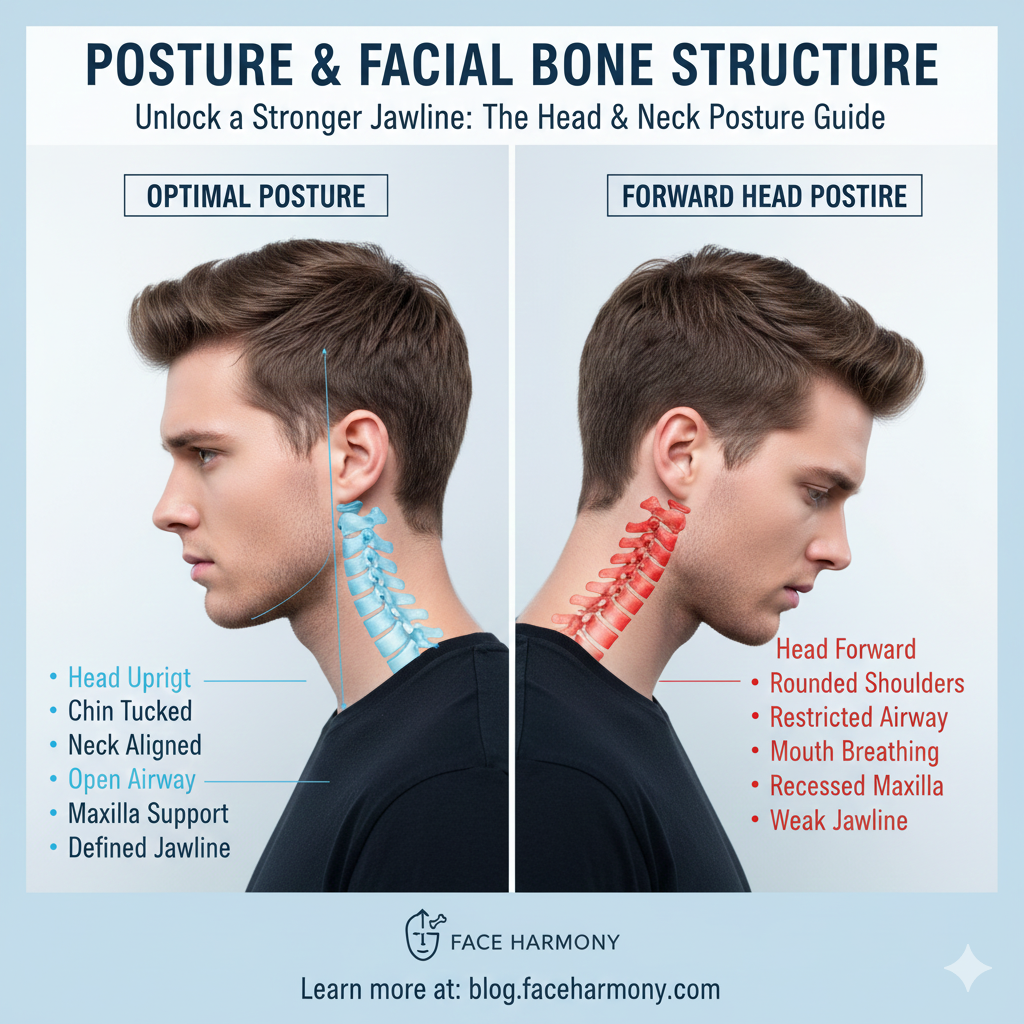
Forward Head Posture (FHP), often called “text neck,” is the most common postural deviation in the modern world.
It occurs when the head is held forward of the body’s vertical midline, causing the ears to be positioned in front of the shoulders.
This seemingly minor shift has major consequences for the face.
For every inch the head moves forward, the weight on the spine increases by an estimated 10 pounds, forcing the neck and upper back muscles to work harder to counteract gravity.
To maintain balance and keep the eyes level with the horizon, the suboccipital muscles at the base of the skull must contract, causing the head to tilt backward (extension) relative to the neck.
This head extension causes the mandible (lower jaw) to rotate downward and backward, making the chin appear recessed and the jawline less defined.
In growing individuals, this chronic downward and backward pull can actively inhibit the forward growth of the maxilla and mandible, leading to a condition known as skeletal Class II malocclusion (a severe overbite) and a long, narrow facial structure Forward Head Posture and Mandibular Position.
FHP also stretches the suprahyoid muscles, which are attached to the hyoid bone, forcing the tongue to drop from the palate and often leading to habitual mouth breathing.
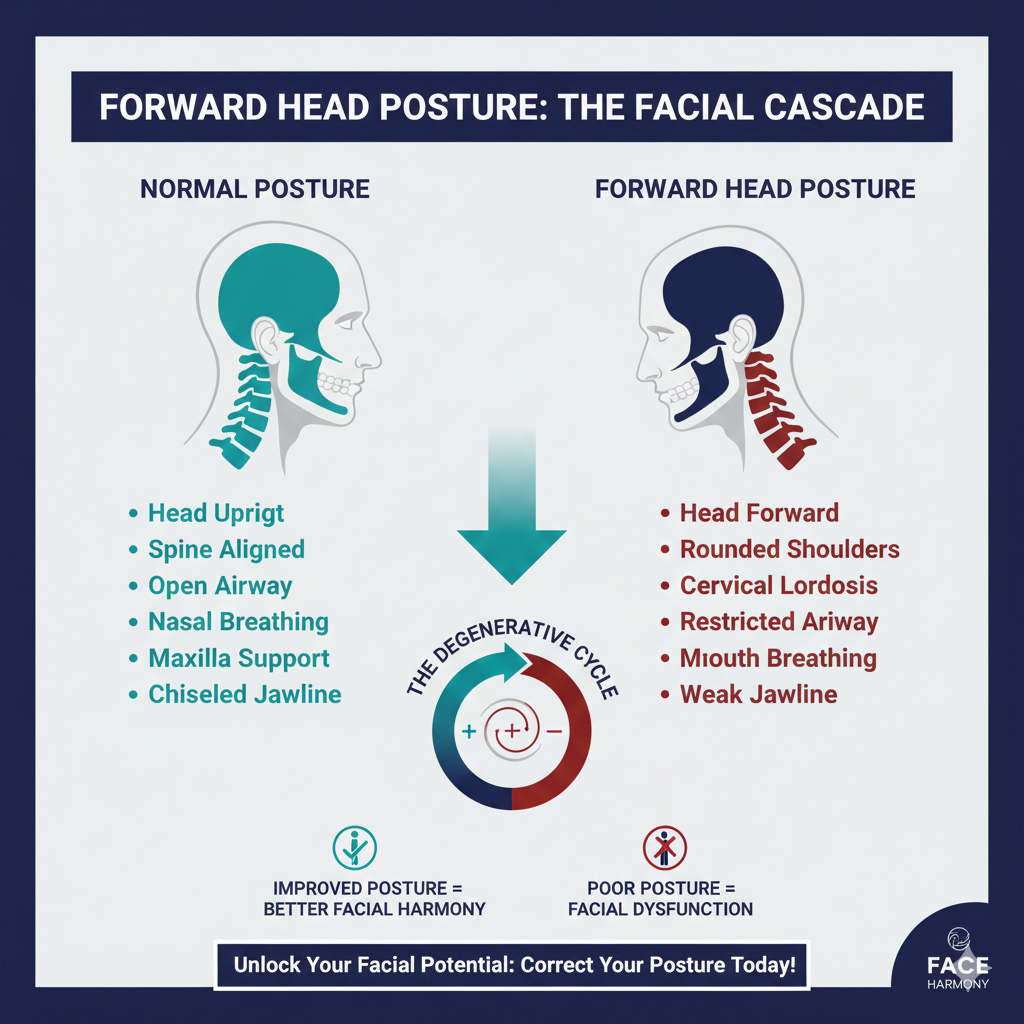
FHP is a self-perpetuating cycle that compromises the aesthetic and functional development of the face.
The Oral Posture Compromise: Breathing and Swallowing 🌬️
The relationship between posture and facial bone structure is inseparable from the concept of oral posture, which encompasses the resting position of the tongue, lips, and jaw.
When FHP forces the jaw to drop, the mouth often opens, leading to chronic mouth breathing.
Nasal breathing is essential for proper facial development because it forces the tongue to rest in the correct position on the palate, providing the necessary pressure for the maxilla to grow wide and forward.
Mouth breathing, conversely, causes the tongue to rest low in the mouth, eliminating the upward pressure on the maxilla.
Without this internal support, the forces from the cheeks and lips dominate, leading to a maxilla that grows narrow and downward.
This narrow maxilla can result in a high, narrow palate, crowded teeth, and a downward-growing face, often referred to as a long face syndrome.
Furthermore, the swallowing pattern is affected. In a correct swallow, the tongue presses against the palate, providing a powerful, momentary stimulus to the maxilla.
In a compromised posture, the tongue often thrusts forward against the teeth, a pattern that can push the teeth out of alignment and fail to provide the necessary bone stimulation.
The link is clear: Poor posture leads to poor oral posture, which leads to poor facial bone development.
Postural Effects on Craniofacial Morphology 📊
Scientific studies, often using cephalometric analysis (X-rays of the head), have repeatedly demonstrated a correlation between cervical spine posture and specific craniofacial features.
| Postural Deviation | Effect on Facial Bone Structure | Aesthetic Consequence |
|---|---|---|
| Forward Head Posture (FHP) | Mandibular downward and backward rotation; Hyoid bone descends. | Recessed chin, weak jawline, appearance of a double chin. |
| Chronic Mouth Breathing | Maxillary constriction; Downward growth of the face. | Long, narrow face, high palate, crowded teeth, gummy smile. |
| Correct Upright Posture | Mandibular forward rotation; Hyoid bone ascends; Maxillary support. | Defined jawline, prominent chin, broad smile, balanced facial height. |
One key finding is the association between a more extended head posture and a larger mandibular plane angle, which is a measure of the steepness of the lower jaw.
A steeper angle is characteristic of a face that has grown more vertically than horizontally, often seen in individuals with long face syndrome Cervical Spine and Craniofacial Morphology.
This evidence underscores that the position of the head is not merely a cosmetic issue but a fundamental factor in the mechanical environment that shapes the facial skeleton.
Corrective Strategies: Reclaiming Your Posture and Profile 🛠️
The good news is that the biomechanical chain can be reversed, or at least significantly improved, through conscious effort and targeted exercises.
Correcting FHP is the first and most crucial step in optimizing your facial bone structure.
A. Postural Correction Exercises
- Chin Tucks: This exercise directly addresses FHP. Sit or stand tall and gently pull your chin straight back, as if making a double chin. This strengthens the deep neck flexors and helps reposition the head over the spine. Hold for 5-10 seconds, repeat 10 times.
- Wall Angels: Stand with your back, head, and arms pressed against a wall. Slowly slide your arms up and down, keeping your lower back flat against the wall. This helps restore the natural curve of the thoracic spine, which supports the neck.
- Scapular Retractions: Squeeze your shoulder blades together and down, as if trying to hold a pencil between them. This counteracts the rounded shoulders often associated with FHP.
B. Oral Posture Training
Once the head is in a more neutral position, it becomes easier to train the tongue to rest correctly.
- Nasal Breathing: Practice breathing exclusively through your nose, especially during sleep (using mouth tape if necessary). This is the single most important habit for supporting maxillary growth.
- Tongue Spot: Train your tongue to rest fully on the palate. The tip should be just behind the front teeth, and the back third of the tongue should be suctioned to the roof of the mouth. This is the foundation of Orthotropics, the study of guiding facial growth.
- Hard Chewing: Incorporate harder foods into your diet to stimulate the masseter muscles and, by extension, the jawbone, adhering to Wolff’s Law.
The Long-Term Aesthetic Payoff 💯
The commitment to correct posture is a long-term investment with significant aesthetic returns.
By maintaining an upright head position and proper oral posture, you are:
- Maximizing Jawline Definition: The mandible rotates forward, eliminating the slack under the chin and sharpening the jaw angle.
- Supporting Midface Projection: The constant upward pressure from the tongue encourages the maxilla and zygomatic arches (cheekbones) to maintain their forward and outward growth vectors.
- Improving Airway Health: A forward-grown maxilla and a correctly positioned mandible create a larger, more open airway, leading to better sleep and overall health.
The face is a dynamic structure, and while adult bone changes are slow, the soft tissue and muscle changes from corrected posture are often immediate and dramatic.
The appearance of a recessed chin or a weak jawline can often be instantly mitigated by simply correcting a forward head posture.
This is not a quick fix, but a fundamental shift in the way you interact with gravity, leading to a more balanced, defined, and healthy facial structure over time.
https://youtu.be/YOUTUBE_URL_1
https://youtu.be/YOUTUBE_URL_2
https://youtu.be/YOUTUBE_URL_3
Key Takeaways and Actionable Steps ✅
- The Hyoid Link: The hyoid bone connects head posture to tongue position, which is the key to maxillary growth.
- FHP is the Enemy: Forward Head Posture causes the jaw to rotate down and back, leading to a recessed chin appearance and compromised growth.
- Corrective Habit: Practice the Chin Tuck exercise daily to strengthen the deep neck flexors and reposition the head.
- Oral Posture: Ensure 24/7 nasal breathing and maintain the tongue fully on the palate (mewing) to provide internal orthopedic support.
- Long-Term Goal: A neutral head posture and correct oral posture are essential for maximizing the genetic potential for a strong, forward-grown facial structure.
Your posture is the architect of your face—start building a stronger foundation today.
Stand tall, breathe through your nose, and let your tongue do the work! 📌